Implementation of workplace safety management policy
Creating a Happy Workplace: Sustainable Safety and Health Practice
Advantech views occupational health and safety (OHS) as a core strategy and is committed to building a solid OHS culture. We effectively prevent workplace accidents by raising employees’ safety awareness and creating a high-quality safety atmosphere. We not only abide by Taiwan’s laws and regulations, but also align ourselves with global occupational safety issues, and have incorporated fire safety management. By establishing a comprehensive management system and combining it with risk management, we ensure that all employees have a healthy, safe, and harmless work environment, thereby fulfilling our commitment to zero occupational accidents and comprehensive healthcare in the workplace.
Occupational Health and Safety Management System (ISO 45001:2018)
Advantech is committed to providing a safe and healthy work environment, and has established and implemented the ISO 45001 Occupational Health and Safety Management System(OHSMS) (including fire safety management). We further required all plants to implement systematic management in accordance with ISO 45001 in 2025. At the same time, the Board of Directors approved the “Occupational Health and Safety Management Policy,” which has been implemented and announced on the official website. The OHSMS covers all workers, including Advantech employees and non-employee workers. We have implemented the system from the top down to OHS personnel in each region, who comply with the ISO 45001 management system and are responsible for planning, implementing, supervising, and auditing system operations.

Occupational Health and Safety Education and Training
Safety and Health Performance Indicators
Occupational Hazard Identification and Risk Assessment
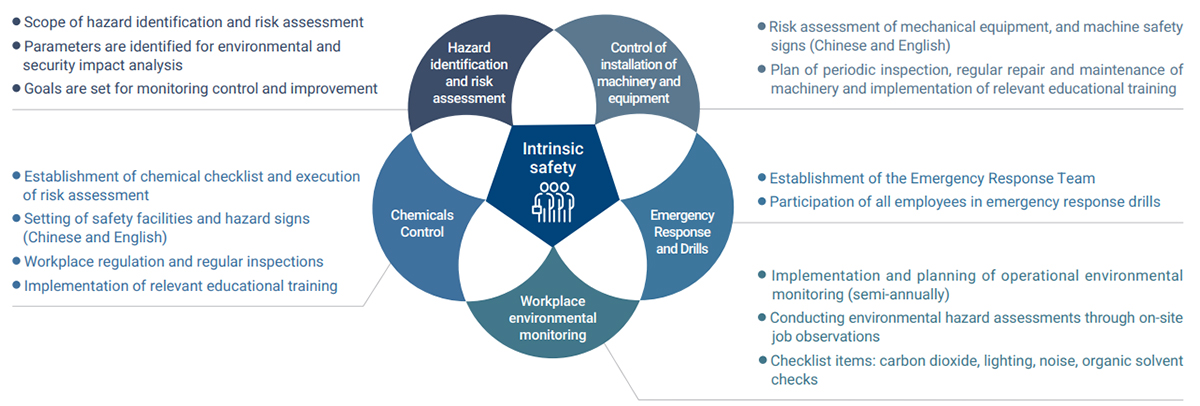
To prevent the occurrence of occupational hazards, Advantech has established procedures for identifying environmental considerations and safety and health risks and opportunities, assessing the hazards and risks arising from operation activities (including routine and non-routine) to employees, stakeholders, or the work environment, and identifying risks that need to be controlled and opportunities for improvement. We analyze the impact on safety and health based on the parameters used for identification, and rank the risks that are identified. Based on the results of the risk identification and assessment, prioritize the risk and identify those requiring action plans, feasible and optimal control measures are determined in the following order: elimination, substitution, engineering control, operation control, and personal protective equipment, and then establish management plans and targets for monitoring, control, and improvement. Based on the workplace environmental risk assessment results, fire is identified as a high-risk factor, while hazardous chemicals, noise, and ionizing radiation are categorized as medium risks, with the remainder classified as low risks. To address high-risk environments such as fire, comprehensive fire protection equipment is provided. For medium-risk environments involving hazardous chemicals, noise, and ionizing radiation, personal protective equipment (PPE) is supplied, and regular special health examinations are arranged to track and ensure the workplace health of operators.
Regarding potential hazards and risks in the workplace, we also comply with Article 18 of the Occupational Safety and Health Act and Article 25 of the Enforcement Rules of the Occupational Safety and Health Act concerning the criteria for “potential imminent danger.” Employees are informed and educated that if they encounter a situation posing an imminent danger during work (including abnormalities that occur in the early stages of a fire accident), in addition to immediately reporting the incident, they may evacuate to a safe location without penalty. This policy further ensures employee safety and health.
Advantech arranges fire safety and chemical leakage drills for each plant each year, and regularly inspects areas with potential fire risks to ensure the effectiveness of response mechanisms. Complete drill records include: the exact date of the drill, customized response scripts, the participation of all members of the fire self-defense team, and post-drill review meetings. We attach importance to every feedback we receive for improvement, and view it as an important basis for improving the safety of plants
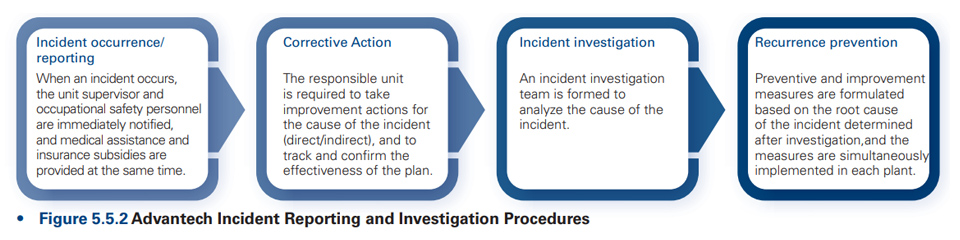
Incident notification and investigation procedures
With the ultimate goal of achieving zero workplace accidents, Advantech formulated the “Occupational Incident Investigation and Handling Regulations” to clearly regulate the process of incident reporting, responsibilities for incident investigation, subsequent improvement actions, and prevention of recurrence. (In 2025, a near-miss fire incident occurred during a contractor's acetylene welding operation. The fire was extinguished immediately, resulting in no casualties or property damage. Nevertheless, the contractor was required to conduct a Root Cause Analysis (RCA), implement corrective and preventive actions, and strengthen their emergency response capabilities moving forward.)
Disabling injury statistics analysis
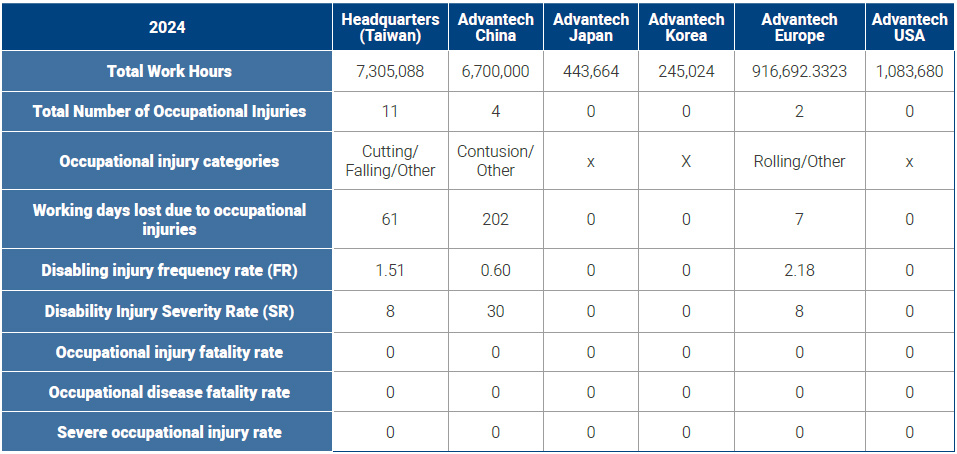
1. Total working hours (headquarters): Total working hours are based on monthly data from the Occupational Safety and Health Administration, Ministry of Labor.
2. Total working hours (other regions): Number of employees in each region * Number of working days in the year * Number of working hours per day.
3. FR = (Total number of injury losses × 1,000,000) ÷ Total hours worked (rounded to the second decimal place).
4. SR = (Total number of days lost due to injury × 1,000,000) ÷ Total hours worked (rounded down to the nearest whole number).
5. Occupational injury fatality rate = Number of fatal work-related injuries ÷ Total number of work-related injuries.
6. Occupational disease fatality rate = Number of fatalities as a result of work-related ill health ÷ Number of cases of work-related ill health.
7. Occupational diseases: Determined by an occupational medicine specialist, local competent labor authority, or the Occupational Safety and Health Administration, Ministry of Labor.
8. Occupational Injury Absenteeism Rate = (Total days absent due to work-related injuries and ill health/Total number of workdays) x 100%.
9. Serious occupational injury rate: The worker cannot fully recover from the injury within 6 months, excluding fatalities.
10. The data above exclude commuting accidents.
11. Statistics on the number of employees up to December 31, 2025.

1. Non-Advantech workers: Security, cleaning, catering, and temporary workers.
2. Total working hours (headquarters): Total working hours are based on monthly data from the Occupational Safety and Health Administration, Ministry of Labor.
3. Total working hours (other regions): Number of employees in each region * Number of working days in the year * Number of working hours per day.
4. Occupational injury absentee rate: (Total number of days absent (occupational injury leave)/Total number of workdays) x 100%.
5. Serious occupational injury rate: The worker cannot fully recover from the injury within 6 months, excluding fatalities. The Serious occupational injury rate for the reporting period was 0.
6. The Total Recordable Injury Rate (TRIR) is calculated as follows: Number of recordable occupational injuries × 200,000 ÷ total hours worked. The TRIR for the reporting period was 0.
7. Occupational diseases: Determined by an occupational medicine specialist, local competent labor authority, or the Occupational Safety and Health Administration, Ministry of Labor.
8. Statistics on the number of employees up to December 31, 2025.
Employee Absentee Rate Statistics
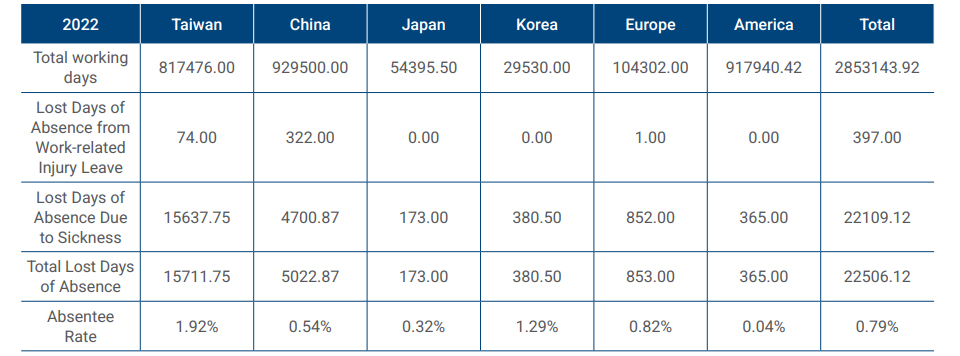
1. Absentee rate calculation method: (Total days of absence (occupational injury leave + unpaid sick leave)/Total work days) x 100%.
2. Absentee rate calculations do not include leave that was planned or approved in advance, such as: personal leave, annual leave, maternity leave, paternity leave, and official leave.
Comprehensive Response Mechanisms: Deepening Employees’ Fire Safety Knowledge and Abilities
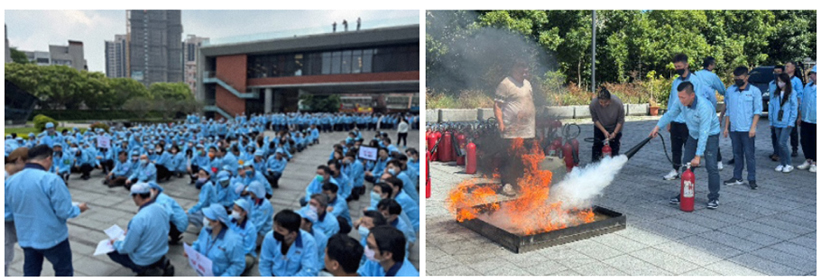
Advantech is committed to creating a safe workplace. In addition to conducting fire drills in accordance with the law, we also use evacuation simulations to improve the accuracy of evacuation. In 2025, we planned a fire drill with real fire to strengthen employees’ mental resilience and disaster relief capabilities in emergencies. We transform safety awareness into voluntary actions, build a comprehensive line of defense against disasters, and fulfill our commitment to employee safety and well-being through systematic empowerment.
Advantech Headquarters not only conducts regular fire drills and evacuation drills for all employees, but also planned a “real fire simulation” for employees to experience what it is like to be in a fire in a safe and controlled environment, and for them to practice using fire extinguishers. This “immersive” drill broke the boundaries of traditional awareness campaigns, and significantly improved employees’ mental resilience and disaster mitigation capabilities in the event of an emergency, ensuring the best protection for Advantech’s assets and employees’ lives.
Health Management: Building a Workplace that supports employee well-being
Due to the rapid changes in the global business environment, Advantech firmly believes that talent maintenance has shifted from basic labor conditions to comprehensive welfare management. Employees’ physical and mental balance is the key to corporate resilience and operational efficiency. Our health services encompass health examinations (including special health check-ups), health promotion activities, Employee Assistance Programs (EAPs), onsite physician consultations, and the tracking of four major health management plans. We provide employees with comprehensive health information through various channels, such as seminars, activities, competitions, and newsletters. Health hazards can be identified through health examinations and questionnaires, and subsequent risks can be minimized through health management and health promotion initiatives.
In terms of disease prevention, Advantech has implemented a health education system based on seasonal health risks to achieve more effective disease prevention. In 2025, Advantech integrated the information of external hospitals and designed the “influenza vaccination map” to help employees quickly search for vaccination resources in different regions to prevent the flu from spreading, improving the convenience of vaccination and the resilience of public health in the workplace. This action combines health management and technology applications to comprehensively strengthen the resilience of public health in the workplace.
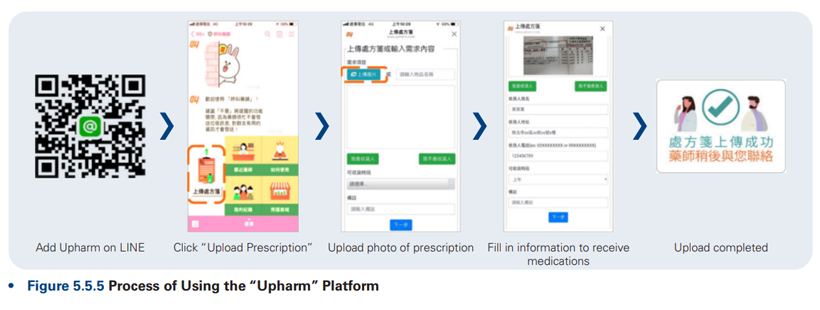
We partnered with the “Upharm” platform to launch the exclusive service “Receive medication at the company with one click” to make it more convenient to fill prescriptions for chronic diseases. Employees only need to upload their chronic disease prescription through the exclusive LINE account, and a pharmacist will prepare the medications and directly deliver them to Advantech. This service also extends care to employees’ families, saving employees the hassle of traveling to hospitals and queuing for medication, while ensuring family members can conveniently access their required treatments. Advantech has created a thoughtful workplace environment through digital health services, fulfilling our commitment to deliver mutual benefits for employees and their families.