
Visions, Goals, and Strategies
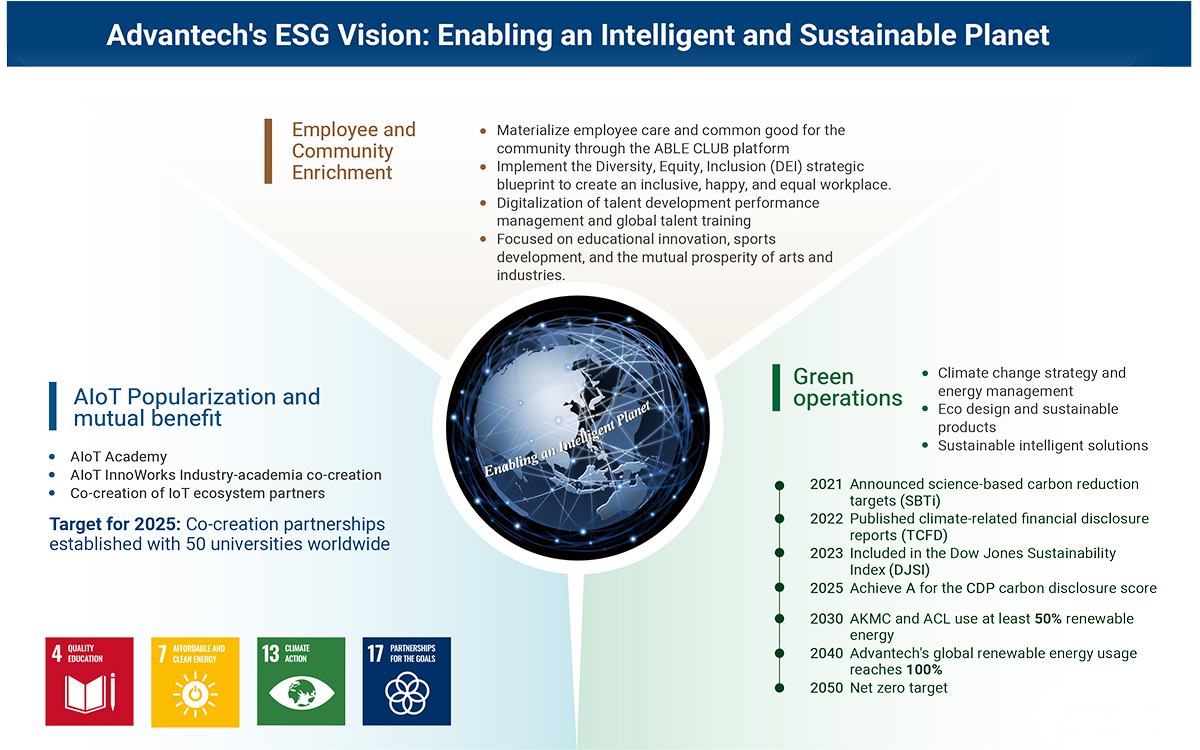
In August–September 2020, Advantech ran the 2025 Vision Depiction Workshop. In September, we officially established the 2025 Vision Declaration, and ESG is a critical part of this. Advantech’s ESG Vision Declaration is as follows: “Emphasize environmental, social, and corporate governance topics, implement Lita co-enrichment, and enable an intelligent and sustainable planet.”
Advantech’s ESG vision began with our corporate vision of “Enabling an intelligent planet.” Considering our core competitiveness, key development strategies, and response to the UN SDGs, we aim to leverage our AIoT core competencies and smart solutions to assist in realizing SDG 7 and SDG 13 for improved energy efficiency, energy-saving in buildings and in manufacturing, and low carbon emissions in logistics and retail. Through our open, innovative environment and education efforts aimed at popularizing IoT platforms and solutions, we seek to provide outstanding education (SDG 4) and promote partnerships (SDG 17).
Advantech 2025 Vision and our focuses on UN SDGs
Advantech’s Management Guidelines for Material Issues
| Information Security Management | |
|---|---|
| Information Security Management | |
| Information Security Management |
Advantech is a global leader in the IoT industry. Information security directly affects our operational stability and product security, both of which are extremely important to our brand value, employees, customers, and investors. In addition, the FSC amended the law to clearly stipulate information security requirements for listed companies, which are required to make a material information announcement when a major information security incident occurs. |
| Policy or commitment | |
| Policy or commitment |
Advantech deeply recognizes that information security is the cornerstone of corporate sustainability and the trust of stakeholders. Facing the information security risks brought by digitization and the rapid development of cloud applications, one of our core business strategies is to continue strengthening information security governance and protection capabilities. At the same time, we continue to invest resources in information security technology upgrades and employee awareness training, which improves our overall security resilience and incident response capabilities. This ensures the protection of customer data, operational information, and system stability, thereby fulfilling our long-term commitment to shareholders, customers, and the general public. |
| Positive impact | |
| Positive impact |
Recognizing the positive impacts and growing importance of information security within the technology supply chain, Advantech’s efforts to strengthen cybersecurity build customer confidence while reinforcing overall risk management and operational resilience. |
| Negative impact | |
| Negative impact |
Information security breaches can negatively impact business operations through the leakage of confidential information and system service interruptions, which can damage Advantech’s reputation, result in a loss of business and customers, and create litigation risks. Financial impact of potential negative impacts: If hardware failure occurs in critical systems (such as ERP) and data needs to be recovered, it will cause services to be suspended for approximately 4 hours and result in a loss of approximately NT$37.8 million (consolidated scale of 50E) or NT$22.72 million (consolidated scale of 10E) in revenue/production capacity. If files need to be restored from backup due to being encrypted by hackers, the impact could last for up to 24 hours, and the financial impact is estimated at approximately US$4 million, along with any losses resulting from potential data leakage. The main quantitative risks of an R&D/customer core data incident is a loss of approximately US$1.5 million for data recovery by PLM and R&D, and approximately US$5 million from the impact on customer relations and reputation.
|
| Actions in response to negative impacts that occur | |
| Actions in response to negative impacts that occur |
When an information security incident (such as data leakage) occurs, the organization immediately activates a response mechanism, isolates the affected system to prevent its spread, and investigates the incident while assessing losses. The incident is reported internally to management, while the competent authorities and affected users are notified externally in accordance with regulations, with remedial measures promptly provided. Following an incident, vulnerabilities are reviewed, and controls and training are strengthened to reduce the risk of recurrence. |
| Overview of target achievement in 2025 | |
| Overview of target achievement in 2025 |
|
| 2026 targets | |
| 2026 targets |
|
| 2030 targets | |
| 2030 targets |
|
| Key action plans or programs in 2025 | |
| Key action plans or programs in 2025 |
|
| Effectiveness assessment | |
| Effectiveness assessment |
|
| Stakeholders affected by this material topic and actions taken by Advantech | |
| Stakeholders affected by this material topic and actions taken by Advantech |
|
| Green Eco Design and Sustainability Liability of Product | |
|---|---|
| Green Eco Design and Sustainability Liability of Product | |
| Eco Design and Sustainability Liability of Product |
Advantech regards eco design and product sustainability as both risks and opportunities. Facing strict regulations and market demands, we need to strengthen R&D in the short term to overcome technology barriers, and drive supply chain transformation in the medium and long term to enhance our competitiveness and create environmental and economic benefits. |
| Policy or commitment | |
| Policy or commitment |
Advantech responds to SDG 9 (Industry, Innovation and Infrastructure) and SDG 12 (Responsible Consumption and Production) by setting goals and implementing standards for product raw materials, design, manufacturing, and environmental management, dedicating our efforts to producing eco-friendly products to minimize our impact on the environment. |
| Positive impacts | |
| Positive impacts |
|
| Negative impacts | |
| Negative impacts |
|
| Actions in response to negative impacts that occur | |
| Actions in response to negative impacts that occur |
|
| Overview of target achievement in 2025 | |
| Overview of target achievement in 2025 |
|
| 2026 targets | |
| 2026 targets |
|
| 2030 targets | |
| 2030 targets |
|
| Key action plans or programs in 2025 | |
| Key action plans or programs in 2025 |
|
| Effectiveness evaluation | |
| Effectiveness evaluation |
|
| Stakeholders affected by this material topic and actions taken by Advantech | |
| Stakeholders affected by this material topic and actions taken by Advantech |
|
| Innovative mechanism | |
|---|---|
| Innovative mechanism | |
| Innovative mechanism |
Advantech systematically invests in products and technologies, business innovations, and mechanisms to thrive together with partners in the ecosystem under the corporate vision of "Enabling an Intelligent Planet." |
| Management strategy | |
| Management strategy |
Based on the vision defined in 2015 and the “AIoT Development Roadmap,” we view AIoT as the engine for future industry growth, and have adopted various approaches to innovation, repositioning Advantech from an IPC manufacturer to an industrial IoT device to cloud total solutions provider. Advantech currently has innovation mechanisms for roughly 6 items under 3 categories, including products, technologies, business, and collaboration with academia. In 2025, Advantech set its sights on becoming the leading brand in edge computing & edge AI, and led the world in innovation in 5 major fields, namely intelligent edge systems, smart energy, smart manufacturing, smart healthcare, and smart hospitals. Advantech developed innovation mechanisms specifically for products, technology, business, and collaboration with academia. |
| Policy or commitment | |
| Policy or commitment |
We elevated innovation management from being process-driven to the level of corporate development, which is an important approach for developing emerging business opportunities. We strategically communicate the concept of strategic cooperation and co-creation with external partners, and encourage diverse innovation proposals and execution flexibility to seize opportunities that arise from the development of the AIoT industry. |
| Positive impact | |
| Positive impact |
|
| Negative impact | |
| Negative impact |
Technical risks and possibility of failure. There is the risk of technical failure, or low market acceptance in the process of adopting new technologies or innovation mechanisms, resulting in a waste of funds and time.
|
| Overview of target achievement in 2025 | |
| Overview of target achievement in 2025 |
2025 targets
|
| 2026 targets | |
| 2026 targets |
|
| 2030 targets | |
| 2030 targets |
|
| Key action plans or programs in 2030 | |
| Key action plans or programs in 2030 |
|
| Effectiveness evaluation | |
| Effectiveness evaluation |
Advantech evaluates the effectiveness of its innovation mechanisms through internal reviews and external validation. We monitor the speed of new product launches, revenue growth, and patent application results during quarterly and annual business group reviews. The results are fed back into IMAX-C, EBO, TSU, and industry-academia collaboration projects to continuously track and optimize the maturity of technologies and business models. At the same time, we participate in major international awards and industry competitions, and use these recognitions and market reputation to validate Advantech’s innovation standards, ensuring that sales and technological innovations can truly bring positive economic, social, and environmental benefits. |
| Stakeholders affected by this material topic and actions taken by Advantech | |
| Stakeholders affected by this material topic and actions taken by Advantech |
Innovation strategies and directions are linked to decisions made by the board-level Sustainability Development Committee (SDC). We employ external scholars and consultants to evaluate innovation proposals. We engage in co-creation with startups, schools, and research institutes or strategic cooperation and investments with companies in the ecosystem for project implementation. Within Advantech, we horizontally integrate investment units, strategic units, innovation management, products of business units, and R&D units to jointly engage in innovation and co-creation. |
| Circular economy | |
|---|---|
| Circular economy | |
| Circular economy |
Advantech is driven by the corporate vision of “Enabling an Intelligent Planet,” and reduces waste and carbon footprint through recycling. We also consider how to change the linear process that generates waste into a closed-loop sustainable cycle for environmental sustainability and to improve resource utilization efficiency. This will mitigate the environmental impact of product manufacturing, while improving energy efficiency and the use of sustainable materials, improving the environmental benefits and competitiveness of our products. |
| Management strategy | |
| Management strategy |
|
| Policy or commitment | |
| Policy or commitment |
Advantech is committed to making every effort to protect the environment, and strives to achieve zero pollution from production. We will fulfill our responsibilities as a global citizen by actively pursuing sustainable development. Advantech is committed to implementing green operations, green product design, pollution prevention, waste management, and green procurement. We work with customers, suppliers, and contractors to jointly establish a green supply chain from design and manufacturing to product transportation and services, implementing energy conservation, emission reduction, recycling, and circular economy. |
| Positive impact | |
| Positive impact |
Creating a circular economy can improve the efficiency of product resource use, reduce the use of non-renewable resources, lower production costs, reduce waste, make products more eco-friendly, improve resource utilization efficiency, reduce the impact on the environment and product carbon footprint, and improve the environmental benefits and competitiveness of products. |
| Negative impact | |
| Negative impact |
The inability to keep up with the trend of green products will reduce the environmental benefits and competitiveness of products. In the long term, it may lead to panic buying of virgin resources and raw materials, increase procurement volumes and waste disposal expenses, and also directly impact our reputation and brand image. |
| Actions in response to negative impacts that occur | |
| Actions in response to negative impacts that occur |
The actions taken by Advantech in response to negative impacts are as follows:
|
| Overview of target achievement in 2025 | |
| Overview of target achievement in 2025 |
|
| 2026 targets | |
| 2026 targets |
|
| 2030 targets | |
| 2030 targets |
|
| Key action plans or programs in 2025 | |
| Key action plans or programs in 2025 |
|
| Effectiveness evaluation | |
| Effectiveness evaluation |
|
| Stakeholders affected by this material topic and actions taken by Advantech | |
| Stakeholders affected by this material topic and actions taken by Advantech |
|
| Sustainable Intelligent Solutions | |
|---|---|
| Sustainable intelligent solutions | |
| Sustainable intelligent solutions |
Advantech's main business groups include: the Embedded Sector, Intelligent System Sector, IoT Automation Sector, and Intelligent Service Sector, which focus on providing diverse application solutions for customers in 5 key markets, namely edge intelligence systems, smart manufacturing, energy and utilities, intelligent healthcare, and intelligent service. At Advantech, we have embraced the trend of edge computing and artificial intelligence (AI), and have bolstered our global presence and enhanced our core competitiveness by focusing on edge computing and edge AI. We will accelerate the deployment of AI in manufacturing, logistics, cities, and energy at scale through the cloud-edge collaboration framework by integrating the edge computing hardware platform product group, industrial IoT software platform WISE-IoT, and crosschip edge AI platform architecture WEDA. We will then incorporate industry edge AI solutions and industry knowledge to reshape our business model into collaborating with industries in the co-creation of integrated applications, and help our partners and customers connect within the industry chain. Furthermore, we are working with partners in each industry to "co-create" an industry ecosystem that will bring us faster to the goal of industrial intelligence. |
| Policy or commitment | |
| Policy or commitment |
Advantech is committed to incorporating the concept of sustainability into the new product development and market expansion strategies of business units. This includes: product sustainability responsibility, expanding the involvement of related product departments (environmental protection and energy, smart healthcare, smart agriculture, environmental monitoring, smart transportation, smart agriculture) that contribute to environmental sustainability or social sustainability goals, and expanding the influence of Advantech’s sustainable intelligent solutions. |
| Positive impact | |
| Positive impact |
Sustainable intelligent solutions provide convenience and a positive economic
impact from better efficiency in smart factories, smart transportation, healthcare,
energy management, and smart warehousing. Driven by global labor shortages
alongside Taiwan’s aging population and low birth rates, the transition to automation is
imperative; it will help fill the manpower gap while driving positive economic change
and improving work efficiency.
|
| Negative impact | |
| Negative impact |
Intelligence and AI will replace a portion of the workforce, which will have a corresponding social impact. At the same time, AI will accelerate the polarization of the labor market, the strong get stronger and the weak get weaker. |
| Actions in response to negative impacts that occur | |
| Actions in response to negative impacts that occur |
For methods to respond to negative impacts, please refer to 3.3 IoT Application Promotion and Education. At Advantech, we start with the cultivation of IoT talent, ensuring that workers are not sidelined by AI or technology. Instead, we cultivate talent capable of making good use of technology to drive a positive impact on society. At the same time, we have closed the gap between education and employment, jointly creating industry-academia opportunities, and helping the global talent market cultivate future talents as early as possible. |
| Overview of target achievement in 2025 | |
| Overview of target achievement in 2025 |
The target for 2025 was for sustainable intelligent solutions to account for 57% of revenue, and the actual result was 61.9%. |
| 2026 targets | |
| 2026 targets |
63% of revenue is generated by products or solutions sold for sustainable purposes. |
| 2030 targets | |
| 2030 targets |
67% of revenue is generated by products or solutions sold for sustainable purposes. |
| Key action plans or programs in 2025 | |
| Key action plans or programs in 2025 |
|
| Effectiveness evaluation | |
| Effectiveness evaluation |
|
| Stakeholders affected by this material topic and actions taken by Advantech | |
| Stakeholders affected by this material topic and actions taken by Advantech |
To mitigate our potential impact on employment, we are investing in cultivating industry
talent through initiatives like IoT-related industry-academia collaborations, internship
programs, and online certification courses. We are working to close the gap between
education and employment to bring more IoT innovation talents to the world. For the
contents of industry-academia collaboration in IoT education, please refer to 3.3 IoT
Application Promotion and Education.
|
| Customers and Partners Co-Creation | |
|---|---|
| Co-creation with customers and partners | |
| Co-creation with customers and partners |
As a global leader in the IoT industry, Advantech is dedicated to providing exceptional products and services. Customer satisfaction has a direct impact on Advantech’s brand value, long-term market competitiveness, and customer loyalty. It also impacts the interests of stakeholders (such as employees, customers, shareholders, and partners). Hence, we have developed a model of transparent, efficient, and resilient customer relationship management. Customer satisfaction and the ecosystem of partners are the digital central nervous system at the core of Advantech’s competitiveness. Advantech utilized AI technology and data governance to not only improve operational stability, but also create long-term sustainability value together with partners, responding to environmental and social challenges with stable digital competitiveness that amplifies the overall creativity of the IoT industry. |
| Management strategy | |
| Management strategy |
I. Global strategic integration
II. AI-driven and AI-enabled
III. Co-creating value with ecosystem partners
IV. Data governance and privacy security
V. Customer service quality and satisfaction
VI.Sustainable investment in IoT business
|
| Policy or commitment | |
| Policy or commitment |
Advantech is committed to maintaining high quality customer services, and continuously monitors customer satisfaction indicators to improve the customer experience and ensure our sustainability. |
| Positive impact | |
| Positive impact |
|
| Negative impact | |
| Negative impact |
|
| Actions in response to negative impacts that occur | |
| Actions in response to negative impacts that occur |
|
| Overview of target achievement in 2025 | |
| Overview of target achievement in 2025 |
|
| 2026 targets | |
| 2026 targets |
Customer satisfaction survey:
Digital service upgrade:
|
| 2030 targets | |
| 2030 targets |
Distributor management
The overall revenue from global distribution channels continues to grow to over US$650 million or with a CAGR exceeding 10%. Sector-focused distribution partners and premium distribution partners account for over 50% of revenue and volume. Digital service upgrade: Incorporate supply chain management into Salesforce and integrate key processes of front-line operations and inventory management. This will achieve digitalized and transparent order processing, inventory monitoring, and logistics management in real time, and is expected to improve operational efficiency while reducing resource waste and carbon emissions, thereby achieving environmental protection and corporate governance goals. The CRM achieves a 360-degree perspective of customers, and integrates various systems and interaction data for the sales team to gain a comprehensive understanding of customer needs and provide more accurate and personalized services. This not only increases customer satisfaction, but also provides solid support to Advantech in terms of data transparency and decision optimization. Customer satisfaction survey:
|
| Key action plans or programs in 2025 | |
| Key action plans or programs in 2025 |
|
| Effectiveness evaluation | |
| Effectiveness evaluation |
|
| Stakeholders affected by this material topic and actions taken by Advantech | |
| Stakeholders affected by this material topic and actions taken by Advantech |
|
| Sustainable Supply Chain Management | |
|---|---|
| Sustainable Supply Chain Management | |
| Sustainable Supply Chain Management |
As a global leader in the IoT industry, supply chain issues concern Advantech’s operational resilience and supply chain stability, which affect product quality, brand value, and our long-term competitiveness. For employees, customers, suppliers, and investors, a sustainable supply chain is the cornerstone for common growth and sustainable development. |
| Policy or commitment | |
| Policy or commitment |
Advantech is committed to sustainable supply chain management. We require suppliers to comply with the Advantech Supplier Code of Conduct, and continue to improve our performance in terms of labor rights, occupational safety and health, environmental protection, business ethics, and management systems, jointly building a responsible supply chain to reduce risks and facilitate sustainable development. |
| Positive impact | |
| Positive impact |
Positive impacts from the transition into a sustainable supply chain include effectively reducing the risks of environmental pollution, occupational safety, and labor rights, as well as further improving the environmental and economic benefits of the overall supply chain. At Advantech, we have gained the trust of external stakeholders in our sustainable development and corporate social responsibility through the establishment of a responsible and transparent supplier management system, which further enhances our market competitiveness. |
| Negative impact | |
| Negative impact |
Negative impacts of a sustainable supply chain might be caused by environmental pollution, occupational safety, and labor rights issues caused by suppliers. These issues will weaken Advantech’s brand value, and prices might rise as suppliers transition towards sustainability, which could also lead to delivery delays and unstable quality, putting pressure on product costs. In addition, when some suppliers do not meet sustainability standards, they might need to be replaced or the supply chain might need to be reevaluated, which could lead to short-term operational instability and resource waste, affecting the stability of our operations. |
| Actions in response to negative impacts that occur | |
| Actions in response to negative impacts that occur |
|
| Overview of target achievement in 2025 | |
| Overview of target achievement in 2025 |
Achieved 100% of 2025 targets:
|
| 2026 targets | |
| 2026 targets |
|
| 2030 targets | |
| 2030 targets |
|
| Key action plans or programs in 2025 | |
| Key action plans or programs in 2025 |
|
| Effectiveness evaluation | |
| Effectiveness evaluation |
|
| Stakeholders affected by this material topic and actions taken by Advantech | |
| Stakeholders affected by this material topic and actions taken by Advantech |
Suppliers and contractors:
Advantech conducts supplier evaluations every year, covering quality, procurement, and ESG sustainability management. We hold supplier conferences from time to time to engage in exchanges with suppliers, and also continue to provide suppliers with training and resources for joint development, working together in the development of innovative technologies and the application of new materials. Our sustainability report fully explains supply chain issues, so that they are fully understood by stakeholders. |
| Greenhouse Gas (GHG) Inventory and Energy Management | |
|---|---|
| GHG inventory and energy management | |
| GHG inventory and energy management |
Advantech is committed to reducing GHG emissions and effectively using energy and resourcesand strives to achieve the carbon reduction targets we have publicly committed to ensure that environmental protection and corporate sustainability can thrive together. |
| Policy or commitment | |
| Policy or commitment |
|
| Positive impact | |
| Positive impact |
|
| Negative impact | |
| Negative impact |
|
| Actions in response to negative impacts that occur | |
| Actions in response to negative impacts that occur |
The actions taken by Advantech in response to negative impacts are as follows. For details, please refer to 4.3.2 of this Report:
|
| Overview of target achievement in 2025 | |
| Overview of target achievement in 2025 |
|
| 2026 targets | |
| 2026 targets |
|
| 2030 targets | |
| 2030 targets |
|
| Key action plans or programs in 2025 | |
| Key action plans or programs in 2025 |
|
| Effectiveness evaluation | |
| Effectiveness evaluation |
|
| Stakeholders affected by this material topic and actions taken by Advantech | |
| Stakeholders affected by this material topic and actions taken by Advantech |
|
| Occupational Health and Safety | |
|---|---|
| Occupational health and safety | |
| Occupational health and safety |
Advantech views occupational health and safety as an important cornerstone of sustainable development. We protect the health and safety of employees through systematic management, while improving our operational efficiency, reputation, and sustainability value at the same time. |
| Policy or commitment | |
| Policy or commitment |
We are committed to exert every effort in occupational health and safety, and strive to achieve zero workplace accidents and total healthcare. We will fulfill our responsibilities as a global citizen, and work tirelessly to achieve sustainable development. |
| Positive impact | |
| Positive impact |
Improves crisis management capabilities. The implementation of effective health and safety measures significantly reduces the occurrence of occupational injuries and work-related ill health, and further improves work efficiency and morale. It can also improve our reputation and brand image. |
| Negative impact | |
| Negative impact |
Improper management may also cause negative effects, such as: asset losses resulting in higher costs, employee resentment, lower work efficiency, and impacts on Advantech’s reputation. |
| Actions in response to negative impacts that occur | |
| Actions in response to negative impacts that occur |
The actions taken by Advantech in response to negative impacts are as follows:
|
| Overview of target achievement in 2025 | |
| Overview of target achievement in 2025 |
|
| 2026 targets | |
| 2026 targets |
|
| 2030 targets | |
| 2030 targets |
|
| Key action plans or programs in 2025 | |
| Key action plans or programs in 2025 |
|
| Effectiveness evaluation | |
| Effectiveness evaluation |
|
| Stakeholders affected by this material topic and actions taken by Advantech | |
| Stakeholders affected by this material topic and actions taken by Advantech |
|
| Talent Cultivation and Development | |||||||||||||||||||||||
|---|---|---|---|---|---|---|---|---|---|---|---|---|---|---|---|---|---|---|---|---|---|---|---|
| Talent cultivation and development | |||||||||||||||||||||||
| Talent cultivation and development |
Advantech is committed to creating a learning environment that promotes employees’ growth and enables them to reach their full potential. From new employee orientation to the development of business management skills, we provide comprehensive training resources to support employees’ steady development at every stage of their careers. Advantech’s 4 academies (management, professional, general education, and new employees) and the e-learning platform provide employees with a variety of courses they can flexibly choose from based on their career needs, strengthening their competencies, deepening their expertise, and enabling them to achieve personal growth. To show our commitment to talent development, the highest-level HR manager at Advantech is also a board member and is directly involved in the formulation of relevant strategies. At the same time, we have included education and training indicators in the ESG KPIs of executive level supervisors in major overseas business units, focusing on the integration of sustainability and talent development. |
||||||||||||||||||||||
| Policy or commitment | |||||||||||||||||||||||
| Policy or commitment |
Advantech has adopted an employee-oriented approach and committed to investing in talent development and creating a culture of self-management and continuous learning. Advantech integrates company strategy with individual development plans through the Organization & People Review (O&PR) and performance evaluation system, systematically understanding employee potential and development needs. This is combined with promotions, job rotations, and training courses to establish a comprehensive talent development mechanism. We pass on our business philosophy and core values to cultivate talents with both professionalism and leadership, improve organizational efficiency, and support the succession pipeline for Advantech and employees to jointly move towards sustainable growth. |
||||||||||||||||||||||
| Positive impact | |||||||||||||||||||||||
| Positive impact |
We consider talent cultivation and development to be the cornerstone of corporate
sustainability, and bring the following positive benefits to Advantech and our employees
through a systematic mechanism and abundant resources:
|
||||||||||||||||||||||
| Negative impact | |||||||||||||||||||||||
| Negative impact |
We have identified the following potential risks and negative impacts on Advantech and
employees if we fail to actively implement talent cultivation and development:
|
||||||||||||||||||||||
| Actions in response to negative impacts that occur | |||||||||||||||||||||||
| Actions in response to negative impacts that occur |
To mitigate the potential negative impacts described above, Advantech took the following
actions through systematic mechanisms and management measures:
|
||||||||||||||||||||||
| Overview of target achievement in 2025 | |||||||||||||||||||||||
| Overview of target achievement in 2025 |
Target achievement:

* Note:
|
||||||||||||||||||||||
| 2026 targets | |||||||||||||||||||||||
| 2026 targets |
* Note:
|
||||||||||||||||||||||
| 2030 targets | |||||||||||||||||||||||
| 2030 targets |
* Note:
|
||||||||||||||||||||||
| Key action plans or programs in 2025 | |||||||||||||||||||||||
| Key action plans or programs in 2025 |
The recruitment of outstanding talents is one of the drivers of corporate growth.
Advantech has created the Elite recruitment program inspired by the core concept of
“Right People on the Bus," and invites outstanding talents who are highly aligned with
and recognize the corporate spirit to join the program. We hope that full-time employees
who join the program can successfully adapt to the corporate culture, attain a retention
rate of over 80%, and achieve better-than-average performance in evaluations.
1. Management Academy: Cultivate the competencies of senior, middle, and junior management.
2. Professional Academy: Skills enhancement To accelerate the digital transformation and enhance the core competitiveness of Advantech, we launched the Professional Academy to provide in-depth training on AI technologies and corporate growth strategies, and thereby ensure the cultivation and internal applications of key talents. At the same time, we assist employees with responding to digital transformation through systematic talent development programs, mitigating the potential negative impacts brought by the industry’s transformation, and achieving the common growth of the organization and employees.
3. General Education Academy: Advantech’s General Education Academy promotes compliance and sustainability literacy, DEI and workplace soft skills, cross-departmental learning and exchange, and employee career support resources for all employees, establishing a common language and culture foundation to enhance organizational collaboration and resilience. Key action plans for 2025 are as follows:
To help new employees quickly assimilate into Advantech and boost their careers, the New Employee Hires Academy has established a systematic orientation mechanism for new employees, integrating the Workday system, senior and junior system, and probation period evaluation process, so that new employees and supervisors can monitor their learning progress and key milestones. The “Advantech Culture Experience Camp (ACE Camp)” covers the corporate culture, organizational structure, and vision and mission. ACE Camp facilitates cross-departmental connections and improves understanding of the corporate environment through career experience sharing by managers, team activities, and park exploration. 5. e-learning promotion: Improving platform performance and course participation effectiveness To improve the effectiveness of e-learning and employees’ user experience, Advantech launched the e-learning optimization program in 2024, and took inventory and re-classified courses of Advantech’s 4 academies (management, professional, general knowledge, and new employee hires). Courses with outdated content or low participation rates were removed, and core general knowledge and regulatory courses were reconstructed. We also introduced an automatic assignment mechanism in the system to assign mandatory courses based on employees’ job attributes, improving the immediacy and accuracy of learning. In 2025, we continued to optimize the e-learning platform, focusing on “improving the efficiency of training assignments and learning, strengthening the verification of learning records and data consistency, and improving the user experience and content reach.” This reduced the administrative burden of course affairs and training assignment by supervisors, and improved the traceability of learning data and management consistency. At the same time, the organization and optimization of the role/permission interface and framework is used as the basis for the subsequent implementation of the decentralized management mechanism, in order to support global learning promotion and effectiveness measurement. |
||||||||||||||||||||||
| Effectiveness evaluation | |||||||||||||||||||||||
| Effectiveness evaluation |
To ensure the effectiveness of human resources management measures and sustainable development goals, the Human Resources Department convenes quarterly meetings to set and track the progress of each department in achieving the target for each indicator, and explains and reviews implementation results. We have strengthened goal-oriented management through an ongoing evaluation and adjustment mechanism to ensure that action plans are implemented effectively and continue to be improved, thereby improving overall sustainability management performance. Furthermore, the learning and development plans of Advantech Academy strive to achieve long-term business goals and employee growth. To ensure the effectiveness and actual impact of each learning program, we adopted the Kirkpatrick Four-Level Evaluation Model to comprehensively measure the effectiveness of learning based on feedback from trainees and business results: L1 Reaction: We ensure that the course design meets the needs of participants through satisfaction surveys, in order to provide a better learning experience. L2 Learning: We verify whether participants have successfully mastered key knowledge and skills through tests and practical evaluations. L3 Behavior: We track whether trainees are able to apply what they learned in actual work scenarios, giving them the capacity to act. L4 Results: We analyze the impact of training on business performance and talent development to ensure that learning truly creates value.【Comprehensive evaluation and optimization】 Based on the evaluation results of the 4 levels above, Advantech Academy conducts a comprehensive review and reflection, and adjusts and optimizes the courses based on actual needs. Advantech Academy will continue to dedicate its efforts to increase the influence of talent training through a continuous learning and feedback cycle, and ensure that it can continue to create value for employees and Advantech in the ever-changing market environment. 【Measurement methods for corresponding targets】
1. Online learning participation rate: Records of e-learning platform use and course
completion data are regularly reviewed to determine the progress.
|
||||||||||||||||||||||
| Stakeholders affected by this material topic and actions taken by Advantech | |||||||||||||||||||||||
| Stakeholders affected by this material topic and actions taken by Advantech |
|
||||||||||||||||||||||
About Advantech Technology 2025 Sustainability Report
Editorial Principles
Advantech Co., Ltd. (hereinafter referred to as "Advantech") has published its 2025 Corporate Sustainability Report. This publication serves to transparently and publicly communicate our strategic vision, management approaches, operational milestones, and future improvement roadmaps across the Environmental, Social, and Governance (ESG) spectrum to our stakeholders and the general public.
Published in August 2026, this report documents our key annual initiatives and has been prepared in accordance to the Global Reporting Initiative (GRI) Universal Standards 2021. It also aligns with the Sustainability Accounting Standards Board (SASB) Industry Standards for the Hardware category, satisfies the specific industry disclosure indicators designated by the Taiwan Financial Supervisory Commission (FSC) for the Computer and Peripheral Equipment Industry, and adheres to the AA1000 AccountAbility Principles.
Report Boundaries and Scope
This report's boundary includes significant locations of operation and main factory areas: Advantech has Ruiguang, Yangguang, and Linkou Taiwan (collectively referred to as ACL) and Advantech Kunshan Manufacturing Center (AKMC). Overseas bases include: Advantech Corporation (ANA), Advantech Europe B.V. (AEU), Advantech Japan Co., Ltd. (AJP), Advantech KR Co., Ltd. (AKR), Advantech China Co., Ltd. (ACN). The manufacturing capacity of the aforementioned bases accounts for 100% of Advantech's total manufacturing capacity, the consolidated revenue accounts for 92.8% of the overall Group, and the number of employees accounts for 94.8% of the total number of employees.
Sustainability informationrelated to the aforementioned operational sites and major factory areas is disclosed in this report. Additionally, content regarding the Advantech Cultural and Educational Foundation is provided on a voluntary basis to highlight the Foundation's contributions to ESG initiatives during the reporting period. Any data scope adjustment or data boundary difference within the scope of this report will be marked in the relevant text or chart in each chapter of the report. Advantech's annual report follows International Financial Reporting Standards (IFRS) and covers Advantech along with its subsidiaries and affiliates. The reporting scope differs from that of this Sustainability Report. Only a portion of the companies listed in the consolidated financial statements are included in the list of companies covered by this report. The scope and boundary of this report are detailed in Appendix 3. Within that list, items indicated with an asterisk denote the report's boundary and scope.
Note: Some of the texts and graphs in this report have used abbreviations of their company codes, such as the aforementioned ACL, AKMC, ANA, AEU, AJP, AKR, and ACN. Please refer to the descriptions in "Report Boundaries and Scope" for the full names of the abbreviated names. If the word RBU appears in the chart mentioned above, it refers to the Regional business unit, i.e. AKMC, ANA, AEU, AJP, AKR, ACN. Any mention of headquarters in the text or chart refers to Advantech Ruiguang, Yangguang, and Linkou Taiwan (collectively referred to as ACL). If the information has been re-edited, it will also be explained in the relevant chapter.
External Assurance and Verification
To ensure the highest level of data integrity, transparency,
and credibility, Advantech has engaged independent thirdparty institutions to perform rigorous external assurance and
verification processes:
| Verification / Assurance Body | Scope & Standards Applied |
|---|---|
| Verification / Assurance Body | Scope & Standards Applied |
| SGS Taiwan Ltd. (Independent ThirdParty) |
|
| Pricewaterhouse Coopers (PwC) Taiwan |
|